
The Orchestrated Insurer: Bridging the Gap Between Compliance and Policyholder Experience
By Leslie Sapienza & Nick Lamparelli
In the insurance industry, communication has traditionally been viewed through a binary lens. On one side, there is Marketing: glossy, expensive, and designed to acquire new business. On the other side, there is Operations: utilitarian, regulated, and designed to process existing business.
For decades, these two functions have existed in silos. Marketing sends the brand promise; Operations sends the bill. Marketing speaks in the language of possibility; Operations speaks in the language of risk and regulation.
For the modern insurance carrier, this separation is no longer sustainable.
Today’s policyholder does not distinguish between “marketing” and “servicing.” To them, every touchpoint reflects the brand. A confusing renewal packet damages trust just as effectively as a poor claims experience. Furthermore, the rise of digital-first competitors has shifted the goalposts; “compliance” is now the baseline, not the benchmark.
The solution facing executive leadership is not simply to “digitize” mail or “automate” emails. It is to adopt a communication orchestration strategy. Orchestration moves beyond the simple act of sending a document. It is a holistic discipline that aligns the message (what is said), the method (how it is delivered), and the measurement (what we learn).
Here is how the most forward-thinking carriers are redesigning their communication architecture to turn regulatory obligations into relationship-building opportunities.
Pillar 1: The Message — Moving from Static Data to Predictive Guidance
The first failure point in traditional insurance communication is the content itself. For too long, “personalization” in insurance meant little more than a mail merge that correctly populated the policyholder’s name and address. The rest of the document remained a static block of legal boilerplate.
In an era of hyper-personalization, this approach is a wasted asset. A renewal notice is one of the few times a carrier has the policyholder’s full attention. To waste that moment on generic text is a strategic error.
The Orchestrated Approach:
Modern orchestration uses data-driven intelligence to transform static documents into dynamic, personalized guides. Instead of a “one-size-fits-all” template, the system should ingest policyholder data such as claims history, property changes, and risk profiles to construct the “next best message.”
The Shift: If a homeowner in a coastal region has seen a 15 percent premium increase, the renewal letter shouldn’t just state the new price. It should dynamically insert a module that explains regional risk factors, provides justification for the premium increase, and suggests a higher deductible to lower the premium (or other alternatives).
The Value: This shifts the interaction from transactional (“Pay this amount”) to advisory (“Here is how we are protecting you”). It preempts call center volume by answering the “Why?” before the policyholder picks up the phone.
Pillar 2: The Method — The “No-Fail” Delivery Network
A perfect message is useless if it doesn’t arrive. This leads to the second challenge: the “Delivery Gap.”
Insurers face a unique constraint that other industries do not. A retailer can send an email and, if it bounces, simply move on. An insurer cannot. Regulatory statutes often mandate that specific notices (cancellations, non-renewals, coverage changes) must be delivered with proof. This fear of non-compliance has kept many carriers tethered to expensive legacy print workflows.
The Orchestrated Approach:
Orchestration solves this by creating a “hybrid bridge” between digital preferences and physical requirements. It treats digital and print not as separate channels, but as a single, cascading workflow.
The “Safety Net” system prioritizes the policyholder’s preferred communication channels (print, email, SMS, or portal). However, if a digital notification bounces or remains unopened for a set period (e.g., 48 hours), the system automatically triggers a print workflow to send a physical letter.
Exception Management: In a traditional model, a “Return to Sender” letter is a manual headache that accumulates in the mailroom. In an orchestrated model, that exception is digitized and immediately flagged for action, triggering an SMS to the policyholder to update their address or alerting an agent to intervene.
The Value: This ensures 100 percent regulatory compliance without sacrificing digital adoption. It allows the carrier to pursue paperless savings aggressively, knowing the print safety net will catch any failures.
Pillar 3: The Measurement — Closing the Loop With Insights
The biggest mistake insurers make is treating “Sent” as the finish line. In the old world of mailrooms, once a letter left the building, the job was done. There was no way to know if it was opened, read, or understood.
In a digital-first world, “Sent” is just the beginning of the data collection process.
The Orchestrated Approach:
Actual orchestration requires a feedback loop. It demands a unified dashboard that tracks engagement across both physical and digital channels.
Behavioral Analytics: It is not enough to track delivery rates. Carriers need to track engagement. Did the policyholder spend time reading the “Coverage Changes” section? Did they click the link to “Review Deductibles”?
Continuous Learning: These insights must feed back into the policyholder profile (Pillar 1). If the data shows a policyholder consistently ignores emails but engages with SMS for billing, the system should automatically update their preference profile for future interactions. The system should continuously confirm and validate preferences with the policyholder (preferences can change over time depending on life circumstances).
The Value: This turns communication into a listening exercise. It allows the carrier to refine its strategy in real time, reducing churn and increasing adoption of digital tools.
Conclusion: The Future Is Connected
The insurance industry is currently facing a “talent crisis” and rising operational costs. In this environment, manual intervention is the enemy of scale. Every time a human has to manually re-send a bounced email, draft a custom letter, or answer a routine question about a bill, margin is eroded.
The transition to communication orchestration is more than just about improving the policyholder experience; it is an operational survival strategy. By automating the lifecycle of a communication, from the intelligent creation of the message to the guaranteed delivery and the analysis of the result, carriers can achieve the “holy grail” of modern policyholder engagement:
Operational Efficiency: Drastically reducing manual handling and call center volume.
Risk Reduction: Creating an unshakeable audit trail for every regulatory touchpoint.
Customer Loyalty: Transforming the carrier from a monthly bill collector into a proactive risk advisor.
The technology now exists to treat every policyholder like the only policyholder. The carriers that adopt this orchestrated mindset will define the next decade of
the industry. Those who do not will remain stuck in
the past.
Leslie Sapienza leads OSG’s Insurance Product and Consulting practice to deliver best-in-class policyholder communication solutions. Sapienza has over 35 years of experience in large-scale technology transformations within the insurance sector. Prior to OSG, she led the Prudential Financial’s U.S. Business Customer Communication Management team, where she oversaw all inbound and outbound service communications. Her leadership drove transformative change, implementing print optimization and digital solutions that streamlined communications, improved content quality, and enhanced the customer experience. Sapienza’s career also includes senior management consulting roles, including at KPMG.
Nick Lamparelli is a 30-year insurance veteran, having been in agency, brokerage, and wholesale roles. For the prior 15 years, Lamparelli has been focused on catastrophe analytics, having worked for modeling firm AIR Worldwide (now Verisk), Marsh McLennan as VP of CAT strategy, and QBE as VP of catastrophe modeling. In 2007, Lamparelli co-founded reThought Insurance and became the CUO. reThought is an Insurtech flood MGA using hazard and catastrophe models to execute its underwriting strategy.
Currently, Lamparelli is the managing partner for Insurance Nerds, a marketing agency helping B2B insurtechs market and sell in the insurance ecosystem. He is also the CEO of The Insurance Advocacy Forum of Florida, which promotes and advocates for sound regulations to stabilize and strengthen the Florida insurance marketplace.
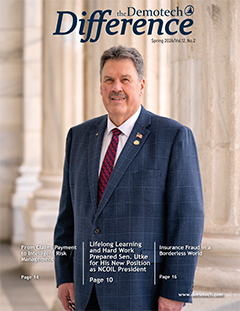
Stay informed with the Demotech Difference Magazine.