
Technology, Choice, and the Next Frontier: Why 2026 Matters for Independent Agents and Specialty Intermediaries
By Ariel Rivera
For more than a century, the independent agency system has been the beating heart of the U.S. insurance market. Independent agents sit at the intersection of carriers, wholesalers, MGAs, and — most importantly — policyholders, translating complexity into confidence. Yet as technology has transformed nearly every other industry, insurance distribution has often remained anchored in manual processes and legacy systems. Recent analysis of specialty intermediaries notes that, even as computing power and connectivity have grown exponentially, efficiency gains in our sector have been modest. That gap between what technology can do and how we actually work is not merely a challenge; it is one of the greatest opportunities of our time.
The Importance of the Independent Agency Distribution Channel
In this environment, independent agents are not becoming less relevant; they are becoming more essential. Clients need a trusted professional who can interpret data, evaluate competing options, and advocate for them when a claim occurs. As product sets proliferate and risk profiles grow more complex, the independent agent becomes the orchestrator of a multi-layered solution — combining admitted coverage, surplus lines, and innovative “bolt-on” programs around a single client relationship.
Technology, when thoughtfully deployed, does not replace the agent’s judgment or relationships. Instead, it amplifies both by delivering better information at the point of sale, surfacing more options in less time, and allowing agents to focus on advice rather than administrative tasks. The future does not belong to “human or digital,” but to those who can artfully blend both in service of the customer. No one has said it better than Kelly Swanson: “AI won’t show up for your customer, YOU will.”
Healthy Admitted Markets, Healthy E&S Markets, and New Program Designs
A resilient insurance ecosystem requires a strong admitted market and a strong specialty and E&S market working side by side. The admitted market anchors standard risks with regulatory oversight, consumer protections, and rate stability. The E&S market, by contrast, offers the agility to underwrite emerging, distressed, or highly specialized exposures. The past decade’s growth in U.S. surplus lines underscores the expanding role of this non-admitted capacity.
Together, admitted and E&S carriers create a continuum of solutions that independent agents can navigate on behalf of their clients, ensuring that few risks are truly “uninsurable.” Agents who understand both sides of this market, and who can explain the trade-offs clearly, become indispensable guides to businesses and households confronting a more volatile risk landscape.
Within that continuum, parametric, bolt-on, and micro-insurance programs are reshaping how we think about protection.
Parametric insurance — where payouts are triggered by predefined conditions such as wind speed, rainfall, or earthquake magnitude — can deliver fast, transparent claim payments and is increasingly being used alongside traditional indemnity policies. Bolt-on and embedded offerings extend this concept to everyday risks: cyber and identity theft coverage added to a business owner’s policy, small limits of equipment breakdown tied to a property schedule, or travel and accident coverage embedded in a transaction. Micro-insurance, often distributed digitally or through multi-industry partners, offers low-premium, streamlined-coverage solutions that are accessible to everyday consumers and small businesses.
In an era of rising deductibles, climate volatility, and widening protection gaps, these designs are not niche experiments; they are practical, affordable tools that can make the difference between recovery and financial distress. Global studies indicate that only a small fraction of the billions of people who could benefit from micro-insurance actually have coverage, highlighting both a moral imperative and a market opportunity.
How Technology Moves the Industry Forward
Market structure alone, however, is not enough. The MarshBerry perspective highlights the scale of the “data deluge” now available to specialty intermediaries: billions of connected devices and staggering volumes of new data each year. When harnessed effectively, this data can transform underwriting, pricing and risk management.
Artificial intelligence and automation are already streamlining the core specialty workflow. Modern platforms can extract and normalize data from submissions, pre-fill applications, run real-time eligibility checks, and ingest third-party data — from telematics to smart-building sensors to public records — to sharpen risk selection. Automation of routine tasks such as rating, documentation, and surplus lines tax calculations frees scarce underwriting talent to focus on complex risks and nuanced negotiations.
The result is not just faster quote-bind cycles; it is a more scalable, consistent, and insight-driven marketplace in which intermediaries and agents can spend more time advising and less time “rekeying.” For carriers and MGAs, this means better portfolio management and a clearer view of emerging risks. For agents and policyholders, it means speed, clarity and coverage that more closely matches real-world exposures.
Why 2026 Could Bring It All Together
So why might 2026 be a pivotal year in this journey?
First, the technology is ready. The tools highlighted in recent specialty intermediary thought leadership — AI-driven triage, automated submissions, behavioral analytics, and IoT-enabled risk monitoring — are no longer experimental. They are live, increasingly user-friendly, and rapidly becoming table stakes rather than differentiators.
Second, the growth of specialty and surplus markets has created a powerful opportunity for well-run, tech-enabled firms to stand out. With premium volumes at record highs and competition intensifying, firms that fail to digitize will struggle to keep pace with peers that offer speed, transparency, and insight as standard features.
Third, the industry dialogue itself has matured. Across conferences, summits, and executive roundtables, leaders are no longer debating whether to embrace digital transformation. They are focused on doing this in a way that preserves the relationship-driven strengths of the independent agency channel while significantly enhancing the customer experience.
At the same time, customer expectations have permanently shifted. Business owners and families now live in a world of real-time banking, same-day deliveries, and on-demand everything. They still want a trusted advisor who knows their story — but they also expect responsiveness, clarity and personalization. The organizations that align human connection with data-driven precision will set the tone for the decade ahead.
An Elegant Future Built on Enduring Foundations
For our amazing industry — carriers, mutuals, specialty intermediaries, and the independent agents who connect them — the message is ultimately hopeful. We are entering a period when healthy admitted markets, robust specialty and E&S capacity, and creative program designs such as parametric, bolt-on specialty, and micro-insurance can work together more seamlessly than ever before. Technology will not change the fact that insurance is built on trust, promises, and the often unseen heroism of agents and underwriters who show up when losses strike. What it will change is our capacity to deliver on those promises faster, more fairly, and to more people.
If 2026 becomes a breakthrough year, it will not be because of any single platform or product. It will be because our industry chooses to pair the enduring strengths of the independent agency system with the full potential of data, automation, and innovative program structures — admitted and non-admitted, macro and micro, traditional and parametric. That is how we honor our history, elevate today’s policyholders, and build a more resilient, inclusive insurance marketplace for the years ahead.
Ariel Rivera’s career spans roles as a cyber insurance program
manager for carriers and MGAs, insurance continuing education instructor, keynote speaker, risk purchasing group integrator, agency owners advisor, podcast host, and industry author. He founded his first independent insurance agency, Ariel Rivera & Associates Inc., in 2007 in San Juan, Puerto Rico, and later established Deer Insurance Agency LLC, in Jacksonville, Florida, in 2019.
In 2020, Rivera launched Fun Insurance Solutions LLC, offering product integration, M&A advisory, and marketing services to the insurance sector. He currently serves as the director of business development at RGS Limited, a prominent cyber insurance program manager and the administrator of the North American Data Security Risk Purchasing Group. Rivera also serves as president of the National Association of Professional Insurance Agents. Rivera’s commitment to others drives his work, embodying his belief that, “Helping others is my passion; insurance is just ONE way of doing it.”
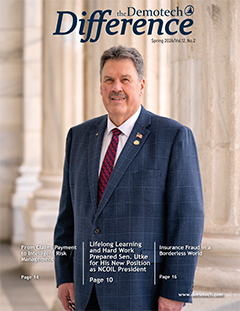
Stay informed with the Demotech Difference Magazine.