
Taking an Overview of Matters in Government
By Noah Marine
The news cycle in Washington moves fast and our attention spans continue to shorten. Even though 2025 will be remembered for the longest government shutdown in U.S. history, the Trump Administration actively pursued its transformational agenda around DOGE, the One Big Beautiful Bill, immigration and border security, and reordering global trade.
And yet, politicians in Washington are already preparing for another election cycle as voters head to the polls in November 2026.
Looking to capitalize on their recent electoral wins in New Jersey and Virgina, Democrats are leaning heavily into an “affordability agenda” hitting Republicans for failing to contain healthcare and housing costs.
Until then, Congress and the Trump Administration have a long list of priorities to accomplish in 2026.
January 30 Funding Deadline and Appropriations
Congress will need to strike a deal on government funding and pass the remaining appropriations bills by January 30 or risk a partial shutdown in February. Several key authorities were extended as part of the deal to re-open the government — including the National Flood Insurance Program and short-term extensions for cyber and homeland security, among others.
Health Care
Healthcare will remain a hot button issue heading into the November mid-term elections as a deal to extend the Affordable Care Act premium subsidies remains elusive. In addition to extending ACA tax credits for stabilizing premiums, other key health care provisions remain unresolved such as funding for community health centers, drug pricing negotiations, pharmacy benefit manager (PBM) transparency, Medicare supplemental payments for rural hospitals, and delaying the scheduled three-year, $24 billion cut to Medicaid.
Tariffs and Trade
All eyes are on the Supreme Court as the justices prepare their ruling in Learning Resources, Inc. V. Trump. The case tests whether President Trump’s use of the 1977 International Emergency Economic Powers Act imposing sweeping tariffs is lawful. The Court’s decision could have a pronounced effect on President Trump’s trade agenda.
The Administration is also preparing a formal review of the United States-Mexico-Canada Agreement and working to finalize additional trade agreements with India, the European Union and China, among several other countries currently engaged in negotiations.
Cryptocurrency
The Trump Administration is actively working to implement the GENIUS Act, legislation establishing a regulatory framework for stablecoins. Lawmakers continue working on broader crypto legislation. Both the Senate Agriculture Committee and the Senate Banking Committee hope to pass a proposal in early 2026.
Cybersecurity
The November continuing resolution (CR) temporarily extended provisions of the Cybersecurity Information Sharing Act through January 30, but ongoing debates may produce a longer-term reauthorization. The White House signaled its support for a clean, 10-year reauthorization opening the door for negotiators on Capitol Hill to continue working towards a resolution. If committee leaders cannot reach a deal in January, a second short-term reauthorization of CISA is likely to ride along with government funding legislation, setting the next expiration at the end of FY 2026.
Farm Bill
The prospects for comprehensive reauthorization legislation have grown increasingly uncertain as we approach the seven-year mark since the last full farm bill was enacted in 2018. With major commodity support and conservation provisions already addressed in this summer’s OBBB, the political dynamics for passing substantial farm bill legislation, including reforming the crop insurance program and regulating hemp, have become even more challenging. Deep cuts made to the Supplemental Nutrition Assistance Program in the OBBB have only deepened the divide between Democrats and Republicans on a typically bipartisan reauthorization process. However, there is agreement across Congress and in the Trump Administration that, after seven years, the farm bill is in dire need of a comprehensive reauthorization, one that considers supply chain disruptions, increased input costs, international market access, and other economic factors that have plagued the food and agriculture industry in recent years.
Housing
As the country grapples with a housing affordability crisis, Congress and President Trump plan on taking several steps to address the persistent issue. The House Financial Services Committee and Senate Banking Committee have each passed separate bipartisan housing proposals. Negotiators will now need to resolve differences and strike a deal to combine the proposals prior to reaching the president’s desk.
Meanwhile, the Trump Administration is debating whether to release Fannie Mae and Freddie Mac from conservatorship. Initially targeted for the end of the year, the Wall Street Journal reported that by releasing the GSEs and selling equity stakes between 5 and 15 percent of the stock of Fannie Mae and Freddie Mac, the transaction could raise around $30 billion at a combined valuation of roughly $500 billion. FHFA Director Pulte noted, “it is critical to ensure any discussion about exiting conservatorship needs not only to ensure safety and soundness but how it would affect mortgage rates.”
Insurance
Although Congress is very cognizant of the McCarron-Ferguson Act and hesitant to directly weigh in on insurance issues, policymakers will need to reauthorize the Terrorism Risk Insurance Act before the current 2027 expiration date.
Similarly, Congress will need to pass another transportation bill in 2026, known as the Surface Transportation Reauthorization, which always attracts debate around auto insurance affordability, auto safety concerns, and autonomous vehicles.
Private Credit and Capital Formation
The Trump Administration is actively bolstering access to private markets and alternative assets, following President Trump’s August Executive Order, “Democratizing Alternative Assets for 401(k) Investors.” It represents a significant push in support of expanding private markets as investment instruments for retirement. The Department of Labor, the Securities and Exchange Commission and the Treasury Department are now tasked with facilitating expanded access to alternative investments in participant-directed retirement plans. This effort will present risks and opportunities for private credit deals, digital assets, and real estate transactions.
Stay Ahead of the Curve
Even in an election year, Congress and the Administration will remain actively engaged in policymaking, searching for leverage with voters. Washington remains dynamic, requiring stakeholders to manage legislative and regulatory risks while looking for unique opportunities to engage.
Noah Marine is a well-known strategist, with nearly two decades of policy and political expertise, in the public and private sector. At Invariant, he advises Invariant’s clients and executives on financial services, insurance, tax, and housing issues. Before Invariant, Marine ran federal government relations for Travelers Insurance. Previously, Marine was the legislative director for Rep. Ed Perlmutter (D-CO), where he served as a senior advisor to the congressman on the House Financial Services Committee.
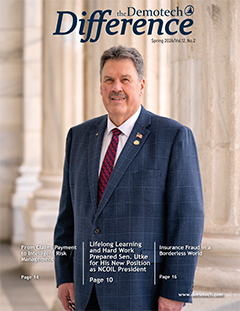
Stay informed with the Demotech Difference Magazine.