
Paul Schneider’s Well-Honed Expertise in Finding the Best Talent for a Company
The Demotech Difference had the opportunity to speak with Paul Schneider about his vast experience in human resources, and what he has found to be important keys to caring for clients and for organizations searching for the best talent.
The Demotech Difference (TDD): Thank you for taking time to share with us. Would you summarize your education, background, and areas of expertise.
Paul (PS): I received my BS in political science from Benedictine College (né St Benedict’s College), Atchison, Kansas. I have a MSIR from Loyola University, Institute of Industrial Relations, Chicago, Illinois. I have 50 years of HR experience. I have held senior level HR positions with Fortune 250 companies, along with working for large family-owned firms. After my corporate experience, I, along with a few partners, started a very successful HR consulting firm with offices in the Midwest. My areas of expertise are consulting, coaching, search, management, and organizational development.
TDD: Before you share thoughts on how the insurance industry could compete for top talent, let’s discuss your career. What was your first job and what did you learn from it?
PS: My first HR position was as an Industrial Relations Representative for Reynolds Aluminum in the Chicago area. You never forget your first title. The plant employed 3000+ employees with nine different unions. I quickly learned that what I learned in college wasn’t totally applicable in a manufacturing facility. Employees want to be heard and treated fairly.
TDD: How did you decide to enter the human resources field?
PS: While I was enrolled in college, we did not have any career courses. It wasn’t in vogue back them. Thankfully colleges are now offering these courses as a mandatory offering. I took a career assessment called the Strong Interest Inventory. I scored high in the areas of “Personnel.” In those days, Human Resources was called either Personnel (non-union) or Industrial or Labor Relations (union focused). So I applied for Personnel/Industrial Relations opportunities.
TDD: From that point, how did you transition to executive search?
PS: In the course of my HR career, one of the functions is recruiting. I was responsible for executive recruiting for the companies where I was employed. When I sold my consulting firm, I had developed a very strong and wide network. It was a logical choice to move into executive search. I am a big believer that having the right skills for a job does not mean you will be successful. What matters is that “culturally” you fit in an organization. I am a big believer in “Cultural Fit.” Americans do not lose their jobs because they do not work hard. They lose their positions because the culture changes.
TDD: What has kept you in this sector?
PS: I like variety. Every search is different. The position is unique: the company has different needs; you meet a lot of interesting candidates.
TDD: Was there a particular lesson, learning objective, or class that proved motivational and important in your career or your perspective on work?
PS: The lesson that I learned was our role is to help each other, whether you work together for the same company or someone needs assistance in finding new employment. People who use other folks to get ahead end up with few close friends.
TDD: Did you have a mentor? If so, what is your most important recollection of his or her advice?
PS: I was lucky. At my first HR job I had a great mentor. He not only taught me about the HR function but how to deal with people. Because of him, I have taken upon myself to mentor many young HR professionals. Life is about giving back, or as some people say, “Paying it forward.” As you move up the corporate ladder, the number of personal mentors decreases, but your ability to mentor others increases.
TDD: Tell us about your philosophy when it comes to assessing the needs of your clients.
PS: I have been on both sides of the table … as a buyer of search and a seller of the services. A good search person listens to the needs of the company. If the professional feels the company’s needs are not in line with the market, then they need to tactfully let the client know. This is accomplished by showing information that backs up their position. If the client wants to move forward with their opinion, you have two choices. The first is to decline the search. The other is to accept the assignment and hope you can change the client’s opinion down the road.
All my clients know me personally. They are aware that I will be straightforward and honest. I will tell them the pros and the cons of the search. Most of all I want to keep them as friends first and clients second.
TDD: What do you view as the most vital area to focus on to provide the best possible service?
PS: Every search and client are unique. To provide the best possible service to your client would be to keep in weekly contact with her. This would be phone calls, emails, sending target lists of companies and potential candidates, etc. There are some search professionals who accept the search and do not stay in contact with the customer. They respond to the client on their own time, not when the client needs them.
TDD: How did your company become a leader in its industry?
PS: Kensington is a boutique search firm. The founding partners after 30-plus years just decided to semi-retire. I have found out search professionals never fully retire. Because we are small, every client is important to us both professionally and personally. We are diligent on who we hire and make sure they fit our culture. Excellent service and close follow-up are traits our clients expect.
TDD: How do we minimize the risk of selecting the wrong candidate?
PS: There are three entities who are involved in the search process. The lead search professional, the candidate, and the company. Each player has a role in the process. The search person needs to make sure the candidate has the skills and personality for the job and company. The candidate needs to make sure that the position, who she is reporting to, and the corporate culture fit her needs. And the company needs to focus on the fit of the person and not so much on all the skills she brings to the job. If all of these are in alignment than the chance of a hire going sideways is reduced.
I always use a sports analogy to get my point across. How many times have you witnessed a team drafting/trading for a player because their skills fit their scheme? How many times have you seen this fail? Move away from the skill and focus more on the fit.
TDD: What is the best advice you ever received?
PS: From my spouse, children or friends? You’re probably talking about business associates. I realized in the middle of my career that it wasn’t so much what you accomplished but how or with whom you accomplished it. It is the people that you work with and develop that makes you personally successful. It’s not your title but the title of others that worked for you.
TDD: What qualities will a person in your role need to possess to be successful?
PS: Be honest with your clients, candidates and yourself. Let the client know if you can or cannot handle the assignment. There have been times when I have been called and asked whether I or the firm could take on a specific search. I have had to tell the potential client that neither I nor anyone else in the firm was qualified to accepted such an opportunity. It’s tough to turn down business. You also have an obligation to get back to candidates and let them know how they “performed” in the interview. Many times you’ll have to tell the candidate that they are not moving forward. However, you need to give them feedback to help them for their next inteview.
TDD: What is your most cherished professional accomplishment?
PS: That I have a lot of professional friends. At the end of the day, it’s about your friends, not your title or money that’s important. I am not fond of the title but in the Chicago area I am called “The Godfather of HR.” I was told that this moniker was bestowed on me because I was always there to help folks that I knew or would soon become friends with.
TDD: What sets you apart in your area of expertise?
PS: That is a tough question, because there are many very good search and HR professionals. I have been told that I am able to quickly understand the culture of the company and the hiring executive.
TDD: Tell us about a setback that was an opportunity in disguise?
PS: We could be here all day. I interviewed for the head of HR for a large, international company. I had great interviews with the president, his staff, the HR staff, except for the CFO. We did not hit it off on many topics. He was a numbers person and very controlling. Needless to say, I didn’t get the job. I decided to follow the company and see who ended up with “my” position. Well, over the next eight years, the company hired and fired six HR leaders. I could have been one of them. It wasn’t until the company released their CFO that stability entered the HR function.
TDD: What advice would you give to someone who wants to do what you do?
PS: Most jobs look easy. That is because the people who populate those positions are professional. If you have an interest in executive search or any other profession, I’d recommend that you interview leaders in that field. Don’t be afraid to reach out to them. I have never met an executive who didn’t want to regale others with their career, including me. You’ll find out not many professionals are asked about what they do or how they got there. Next I would try to shadow that person or someone in their office. It’ll give you an idea of what a typical day is. If you do both of these ideas, you’re 80 percent there in determining if this career meets your needs. Remember, it’s rare that a career lasts a lifetime. So keep on the look-out for your next adventure.
TDD: What are the distinctive competencies of executive search firms?
PS: There are two main types of firms. Boutiques like Kensington or large organizations like Spencer Stuart. Small firms usually focus on specific functions or industries, while large entities are all things to all companies. You can also find firms that specialize in specific positions like finance, human resources, information technology, etc.
TDD: The “graying of the insurance industry” has been discussed for years. It is losing experience and expertise daily as experienced professionals retire. Potential replacements fear that artificial intelligence may eliminate traditional career paths in the industry over time. Let’s transition to your observations on how the insurance industry can, or should, compete for top talent.
PS: I spent time talking to senior human resources professionals in the insurance field. Before I discuss their thoughts about this question, let me go back to your comment on AI. We’ve been around a long time. We can go all the way back to to England in the early 1800s when the Luddites destroyed the cotton and wool machines because they were threatening their jobs. A few years ago, economists spoke about robots replacing workers and declared high unemployment. Or the computer putting all of us out of work. The robot and computer only added more opportunities for safer and better paying jobs. The same will hold true for AI.
I, and the folks that I interviewed, believe the insurance industry needs to re-formulate how they recruit new hires. They need to market the industry differently. Progressive’s Flo and her band of incompetent jesters or Liberty Mutual’s Doug and Emu do not send a professional message to college graduates as an inspiring place to work or for a future career. Insurance companies who are recruiting the best and brightest are changing the messaging. They are talking about how their company is a risk expert for their clients. They are in business to protect their policyholders’ assests and their lives.
Internally, these firms are developing career paths, mentoring programs, internships, job rotations, etc. Their recruiting is focusing more on women and minorities. They are working with colleges and universities to develop specific internship programs. They need to show students and new hires that the insurance industry is not Old School or risk adverse. There are many opportunities outside the sales role such as IT, HR, legal, finance, etc.
These people I spoke to realize that the industry needs to change the outside perspective of insurance … maybe it starts with their commercials.
TDD: How might the insurance industry assess the “readiness” of prospects?
PS: In the past, insurance companies “stole’’ from each other. Some learned that the new hires didn’t come with any new thoughts and ideas. A number are now going outside the industry to fill positions. As I have mentioned previously, culture fit is important. Outside of this assessment, companies are using various assessments to determine whether the candidate has the specific skills to be successful. This alleviates some of the issues that come from hiring managers hiring themselves and not what the job needs.
TDD: Would you share thoughts on why young professionals should consider the insurance industry for their careers?
PS: The insurance industry has been around since at least the 1300s. In the U.S., Ben Franklin helped found the Philadelphia Contributionship in 1752. So, I don’t think it will end even with AI. It is a stable business that is evolving. It offers many career options, from managing your own agency to working for a large insurance firm. The opportunities are endless. Young professionals owe it to themselves to investigate the opportunites. They should spend time talking to insurance executives and not pay attention to their commercials.
TDD: Do you have a closing thought that summarizes your remarkable career?
PS: A career is what you make of it. I have been very fortunate to work with and be associated with many outstanding professionals. They make your career.
TDD: Enough about work — Tell me about your retirement?
PS: When I owned my own firm, we developed a course called “Next Act.” It was designed for people who were looking to change careers or retire. For those that retire, it focused on what is their next career. You cannot play golf, go fishing, etc., every day. What meaningful activities will you begin. This could be the time to give back to your community.
I attended the course and thought about my “Next Act.” I also watched other people who retired and what they did with all their free time. My observation is on the whole, women do a better job of planning for their retirement than men.
I’m on a college board, will be traveling to Europe a couple of times this year, my neighbor and I have a garden; and once my repaired hip heals, I’ll start playing golf, mentor college students, etc. My day is filled but without mandatory meetings.
TDD: You have spent your career assisting others secure employment; any thoughts on how others might prepare for retirement?
PS: I think finances are important when you’re retired; however, I have never heard anyone say they didn’t have enough money in retirement. What concerns me is that people do not go outside themselves and give back to the community. This causes issues with their health.
My suggestion is, prior to retiring, talk to friends who retired. What worked for them. What didn’t work. Contact your local town park district and ask what’s available for retirees. Churches can always use help. There is more to do than you can imagine. You just need a push to get going.
TDD: What is one more goal that you would like to accomplish?
PS: My church just initiated a Parish/Pastoral Council. I happen to be the chair. When my term is up, I want to make sure that it is running smoothly and my replacement is chosen.
TDD: What is one unique or quirky habit that you have?
PS: I don’t think I have any, but ask my spouse, children and friends. I’m sure they can give you plenty.
TDD: Here we go … our Lightning Round of Personal Preferences. Have some fun with this! What was the best movie you’ve seen? Why did you enjoy it?
PS: “To Kill a Mockingbird.” It has a great message for everyone. You need to stand up for what you believe in and help those who are unable to help themselves. Great movie … great book.
TDD: Favorite meal?
PS: Pizza. I’m 25 percent German and 75 percent Irish, and those nationalities are not know for haute cuisine.
TDD: Hobbies?
PS: I have a koi pond in my backyard which takes some time. I like to read, garden, watch my grandchild play sports, spend time on boards, go visit with my friends.
TDD: Favorite memory as a child?
PS: There are a lot, but to choose one I’d say going to the Jersey Shore every summer with my cousins.
TDD: Who was the most memorable person that you ever interacted with?
PS: My spouse … I need the points!
TDD: What is your favorite city to visit, and why?
PS: As a New Yorker, I’d say “The Big Apple.” Outside of NYC, I’d choose Paris. The architecture is fascinating, great history, wonderful museums, terrific food except for snails, and the people are enjoyable once you get to know them.
TDD: If you could go to dinner tonight with any famous personality in the world, who would it be and why?
PS: I would choose the Pope. I am interested in how his upbringing affected him as a leader of the largest religion in the world. What are some of the main issues as leader that bothers him and is there a solution?
TDD: Is there a motto you have to live by?
PS: My mother always said “Do unto others as you would have others do unto you.” Her remarks wore off on me.
TDD: Outside the industry, what would be your dream job?
PS: As a child, a professional baseball or basketball player. However, now that I have matured, I guess a doctor. You have the opportunity to help other people.
TDD: What is something most people don’t know about you?
PS: I can milk a cow. Even my spouse didn’t believe me, but one day at the University of Illinois Agriculture barn, I showed her and anyone in the area my long-lost skill.
TDD: Thank you for sharing your experience, expertise and thoughts. Enjoy retirement.
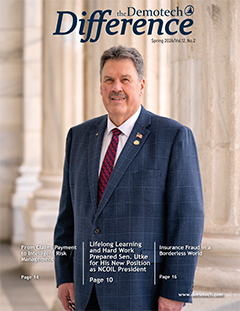
Stay informed with the Demotech Difference Magazine.