
Lifelong Learning and Hard Work Prepared Sen. Paul Utke for His New Position as NCOIL President
The Demotech Difference: Thanks for sharing your thoughts with us. As incoming president of the National Council of Insurance Legislators, our readers will benefit from your thoughts.
State Sen. Paul Utke: It’s my pleasure. NCOIL has always enjoyed a great relationship with Demotech, and I look forward to continuing that during my time as NCOIL president.
TDD: What was your first job as a teenager? What did you learn from that position?
SPU: I grew up on a farm, so we started working earlier in life. When I was 6 years old, I started driving the grain truck in the fields for my dad. From ages 9-12 I hauled the grain from the fields to the farm for my Grandpa. At age 13, my Grandpa had retired, so I went to work for another farmer. Besides all the normal farm work, I hauled grain from the field to town. We got our driving permits at age 13 in North Dakota so sometimes an adult from the farm rode along to make the trip “legal” on the 17-mile trips to town. Life was different back in the ’60s and ’70s in rural America! If you could see over the dash and reach the brake and clutch pedals, you could drive. I worked for farmers every summer until I graduated from college.
What did I learn? Hard work is good for a person.
TDD: How did you first enter the insurance industry?
SPU: I owned a retail hardware and equipment rental business across the street from an insurance agency. Over the years, the owner of the agency and I became good friends, and when I remodeled my building into commercial rental property he talked with me about getting into the insurance business, and I ended up doing just that. I got my P&C license and worked for his agency for a couple of years before moving to another independent agency and working full-time until I started in the legislature.
TDD: Are there people in your career that you would characterize as mentors?
SPU: Yes: the insurance agency owners that talked with me initially about getting into the insurance business were good friends and I would certainly call them mentors. Because of them, I have enjoyed a number of successful years as both a producer and as a legislator working on insurance issues. Like so many people involved in insurance, I never would have imagined growing up that I would be in that line of work. If you surround yourself with good, honest people and you have an open mind, usually good things will happen, and I’m very lucky that I was able to connect with those agency owners at the right time in my life and it led me to where I am today.
TDD: What keeps you focused on the insurance industry?
SPU: Well, above all, it is an industry I really enjoy, since so much of it involves interacting and working closely with people on something very important. People know they need insurance, but most don’t have a lot of knowledge in what they really need in terms of the right coverage and what their options are. That interaction, and helping them understand their risks and needs, is rewarding. And it seems that with each passing year, insurance becomes more important for people, no matter what kind it is. With all that is going on nowadays in terms of affordability and availability challenges, knowing that the work I’m doing is so important to people keeps me very focused.
TDD: Any thoughts on a skill or experience acquired outside of the insurance industry that assists you within the insurance industry?
SPU: A couple of things come to mind. I have worked a lot with building and remodeling homes and commercial buildings. Understanding all phases of the construction industry helps when talking to people about things like replacement costs or construction styles and why some repairs would be much easier or less costly compared to others. I also spent 15 years working for Mack Truck dealers, so when talking about things to people like coverage amounts for automobile policies, I can explain things like the risks they may be encountering when driving on the road with big trucks or other types of vehicles.
TDD: Other side of the coin, what strength or attribute have you had to develop and refine over your career to be more effective in the insurance industry?
SPU: I’d say having an open mind and always being willing to learn. Just when you think you have something down, something new tends to always pop up, and you have to take that opportunity to get outside your comfort zone and expand your knowledge base.
TDD: Which of your personal strengths and attributes have been fine-tuned during your career?
SPU: Well, I truly believe that we continue to learn and grow every day, but something that has been fine-tuned during my career has been my time management skills. I’ve always had strong time management skills due to my background growing up on a farm and working in construction, but those skills have definitely needed to be adjusted throughout my career. There’s a big difference between managing your time and daily schedule around a lot of outdoor activities and requirements compared to scheduling meetings with constituents, holding fundraisers, and managing the daily grind of the legislative session.
TDD: Please share your perspective on your personal learning.
SPU: I take my responsibilities in all facets of my life very seriously, whether it be as a father, husband, insurance agent or legislator. Each of those roles requires a constant effort to learn more and better oneself. When you do that, I think that has a positive effect on everyone around you and on all of your work product — whatever it may be. Specifically, from a legislator perspective, it’s critically important for legislators to always listen to and learn from their constituents. If you don’t, you sure won’t last long in office! Throughout my service in the legislature, so many important issues that I’ve worked on and had the privilege of leading through the legislative process have been because of efforts to take time and truly listen to the concerns of consumers. It’s not always easy, but the end result is well worth it.
TDD: Please share your perspective on how to “educate and inform others?”
SPU: Going back to my answer on personal learning, the first thing you need to do is be a good listener. Once you understand the “others” (i.e., everyone besides yourself!) and what their perspectives are, it is much easier to educate and inform, as you will know what they are looking for or how best to communicate on a level you know they will understand. If you don’t talk to others to begin with, or as the saying goes, only speak in silos, you won’t be able to effectively communicate your message and explain why it’s important. I think it’s more important than ever to branch out and explore different horizons.
TDD: What motivated you to rotate through the chairs at NCOIL?
SPU: I attended my first NCOIL meeting in July of 2018 and I had such a great experience. I really enjoyed the content of the meeting, and I met a lot of nice people, including the NCOIL staff, other legislators from around the country, and interested parties with so many different perspectives on things. First impressions were great, and I have been attending ever since. After having been a consistent attendee and active participant, the timing worked out when there was an opening for an officer position, and I submitted my name for consideration. During my relatively brief time participating in the organization, I sensed that it would be a great opportunity to serve in its leadership to expand my knowledge base and contribute to the important work that it does. I guess the rest, as they say, is history!
TDD: What do you think is the greatest opportunity facing NCOIL in the near future?
SPU: The organization is very fortunate to be on an upswing right now from both an attendance and substantive perspective. I am proud to say that all of our National Meetings last year had over 400 attendees, and our Annual Meeting in November broke all previous NCOIL Meeting attendance records. Overall, we had 134 legislators from 38 states, along with 15 commissioners, directors and superintendents attend our meetings last year. Substantively, we adopted model laws and resolutions on important issues such as: prior authorization reforms; transparency in dental benefits contracting; the workers’ compensation experience rating process; requiring insurers to provide at least 60 days advance notice when nonrenewing a policy; curbing fraudulent activities and ensuring transparency in the auto glass repair process; and ensuring that Health Savings Accounts aren’t inadvertently impacted by certain state laws.
The organization has a tremendous opportunity to leverage this time of success and growth and expand its footprint as a recognized, national, leader in insurance public policy. The timing is good since, as I mentioned earlier, the insurance marketplace is experiencing a significant amount of change right now, so there is a big opportunity for NCOIL to be a leader in developing sound insurance public policy and educating folks on what works and what doesn’t in the marketplace.
TDD: What do you think is the biggest threat facing NCOIL in the future?
SPU: I’m sure several of my predecessors have given this answer, but I think it still remains the case — federal encroachment on the state-based system of insurance regulation. There are always ebbs and flows to this type of unlawful encroachment, but it’s taken center stage recently with the developments surrounding artificial intelligence (AI). Many are preparing for Congress to re-introduce the federal 10-year moratorium on state regulation of AI, and states also now must deal with the recently signed Executive Order that aims to preempt state legislation and regulation of AI. Part of NCOIL’s core mission is to protect and preserve the state-based system of insurance pursuant to the McCarran-Ferguson Act, and that’s why we always need to be ready to react to things like this.
TDD: Anything you can share about your plans for your presidency of NCOIL?
SPU: Overall, I want to continue to advance the organization, both from a legislative membership and substantive perspective. NCOIL is at its strongest when there is robust participation from legislators all across the country that come together to share their thoughts and views on insurance public policy. Throughout my time at NCOIL, I’ve enjoyed the organization’s bipartisan makeup, and that is something that we can’t lose sight of. And from a substantive perspective, I don’t want to shy away from taking on difficult issues such as affordability and availability challenges or ensuring that there is a strong level of transparency throughout the underwriting and claim process, particularly as AI continues to be more prevalent. When you have difficult conversations on important public policy issues, they may not be the most fun to go through, but if you do it right, you often end up with public policy that benefits the most important person — the consumer.
TDD: How do you plan to measure the success of the implementation of your stated goals and objectives?
SPU: From a membership perspective, real progress depends on a larger group of active and engaged legislators. And due to things such as term limits and retirements, it’s critical that the organization continue to grow and attract new legislators to attend so that the value of NCOIL is consistently being displayed. Having new and diverse viewpoints from legislators representing different states, professional backgrounds, and areas of expertise is critical in growing the organization and developing policy that truly reflects the needs of all of our constituents. Substantively, I think measurable success is that NCOIL creates important model laws that end up being adopted across state lines and adapted for different state situations.
TDD: For those who are thinking about entering the insurance industry, would you share why insurance could be an exciting and fulfilling career path?
SPU: Working in the insurance industry not only offers great opportunities for professional development, but also provides a unique way to serve consumers by helping them navigate an increasingly complex marketplace and secure the protections they rely on every day. The industry really does offer a variety of rewarding career paths for individuals of many different talents and professional backgrounds.
TDD: Any closing thoughts?
SPU: I really appreciate the opportunity to allow me to address your readers and to provide my background and plans for NCOIL. Getting involved in NCOIL is one of the best decisions I’ve made as a legislator. The time I’ve invested throughout the years has been well worth it and with each passing year, the value of the organization becomes clearer to me, as insurance is undergoing so much change for so many people. For anyone reading this that isn’t involved at NCOIL, I encourage you to get involved during my tenure as president and beyond. You won’t regret it.
TDD: A lightning round of personal preferences:
TDD: Favorite meal?
SPU: Meatloaf, baked potato and baked squash.
TDD: Favorite snack?
SPU: Ice cream.
TDD: Favorite movie?
SPU: “Wild Hogs.”
TDD: A book you would recommend?
SPU: I don’t read many books but have started listening to audio books. A recent political book was “March to the Majority” by Newt Gingrich.
TDD: Cat or dog person?
SPU: Dog.
TDD: Hobbies that you enjoy or wish you had more free time to pursue?
SPU: I would like to spend more time on my motorcycle touring the country.
TDD: Thank you for speaking with us today.
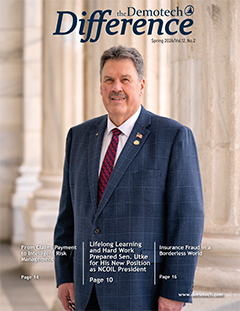
Stay informed with the Demotech Difference Magazine.