
From Claims Payment to Intelligent Risk Management
For more than a century, the fundamental model of insurance has been built on a clear principle: the transfer of financial risk. Under this model, the client pays a premium and the insurer assumes the financial responsibility when an adverse event occurs.
That model remains valid, but it is evolving rapidly.
The industry is moving towards a different paradigm: intelligent risk management.
Rather than limiting themselves to responding when a claim occurs, insurers are beginning to play a more active role in anticipating, preventing, and mitigating the risks faced by individuals and businesses.
This shift is being driven by three major trends.
The first is the explosion of data.
Today, it is possible to analyze behavioral patterns, environmental conditions, driving habits, climate information, and economic variables in real time. This volume of information makes it possible to build predictive models far more sophisticated than those historically used in the industry.
The second trend is technological integration.
Connected devices, sensors, artificial intelligence, and digital platforms allow insurers to monitor risks on a continuous basis. A vehicle can report driving behavior. A building can alert to changes in temperature or humidity that may lead to damage. A company can receive early warnings about potential disruptions in its supply chain.
In addition, the evolution of the claims function is also playing a fundamental role in this transformation. Historically, claims management was viewed as a reactive function focused on the payment of losses. Today, however, claims data has become a strategic source of insight for understanding risk patterns more effectively. Through advanced analytics and artificial intelligence, insurers can identify loss trends, detect potential fraud at earlier stages, and provide valuable feedback to underwriting and risk prevention teams. In this way, claims management is no longer merely the final stage of the insurance process; it is becoming a critical component in strengthening comprehensive risk management.
The third trend is the evolution of modern customer expectations.
New generations expect proactive solutions. They are not looking for a policy only; they want guidance, information, and tools that help them make better decisions.
This creates enormous opportunities for the industry.
Insurers that adopt a preventive approach will be able to build deeper relationships with their customers, improve their technical results, and strengthen the sustainability of their portfolios. By reducing the frequency and severity of losses, these capabilities not only benefit policyholders but also contribute to improving key industry metrics such as loss ratios and the stability of technical performance.
However, this transformation also requires a strategic shift.
Companies must invest in analytical capabilities, strengthen their technical teams, and develop partnerships with technology firms that enable them to integrate new sources of information.
It also implies redefining the role of insurance brokers and advisors. In the future, these professionals will no longer be solely policy sellers; they will become risk consultants, helping clients and businesses navigate increasingly complex environments.
In response to this evolution, many insurers are also transforming their operating models. The integration of technology platforms, advanced analytics, and automated processes is enabling a more agile and precise approach to risk management throughout the entire insurance lifecycle. From underwriting to claims management, these capabilities support better-informed decisions, enhance the customer experience, and strengthen the technical sustainability of operations.
In essence, the insurance industry is shifting from a model centered on the event, the claim, to one centered on risk as a dynamic process.
Companies that understand this transition will be better positioned to create sustainable value over the long term. Because the true future of insurance will not be defined solely by the ability to pay losses, but by the ability to anticipate them, mitigate them, and, whenever possible, prevent them.
Of Italian Venezuelan nationality, public accountant by profession, Rafael Cedeño Camacho is an expert in cryptocurrency mining and holder of the following credentials:
• Global MBA at the University of Miami.
• Global MBA at the University of Berkeley, California.
• Two degrees from the Executive Program of Singularity University in Silicon Valley.
He is currently the founder and president (chairman of the board) of One Alliance Insurance Group, a group of insurance companies with presence in different countries of the Americas (Dominican Republic, Puerto Rico and the United States of America), Axeso (Financing Compa-ny), and One Alliance Travel Assist (World Wide Travel Assistance).
• LinkedIn: Rafael Cedeño Camacho.
• Website: rafaelcedeno.com.
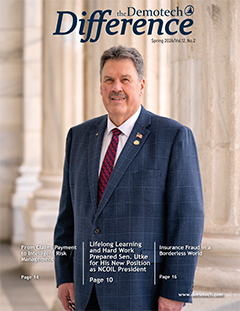
Stay informed with the Demotech Difference Magazine.